
Why do so many whiskey gift sets look similar? Learn how brands can differentiate a whiskey gift set through product design, experience, packaging and gifting strategy.
Why Do So Many Whiskey Gift Sets Feel Interchangeable?
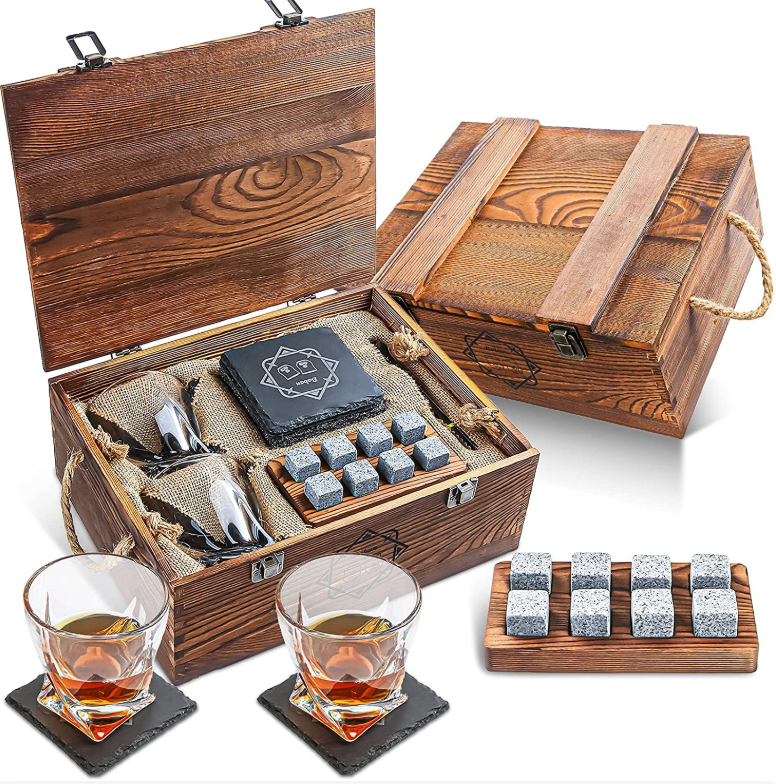
Look through enough **whiskey gift set** options and a familiar product formula often starts to appear:
Whiskey stones or stainless steel chilling cubes.
Tongs or other bar accessories.
Perhaps a decanter or smoker.
Then everything is arranged inside a wooden box, rigid box or presentation package.
There is nothing inherently wrong with this combination. Familiar products can actually be easier for customers to understand.
The challenge begins when different sets offer almost the same reason to buy.
Different brand. Different packaging. Different graphics.
But a very similar product story.
For gift brands, retailers, corporate gifting companies and private-label buyers developing a new **whiskey gift set**, this creates an important product-development question:
**Why should someone choose this set instead of another alternative?**
## More Accessories Do Not Always Mean More Differentiation
When a gift set feels too simple, adding another component can seem like an easy way to create more value.
Another accessory.
More whiskey stones.
Another tool.
A second type of glass.
This can make the package look fuller, but more pieces do not automatically create a stronger concept.
For a **custom whiskey gift set**, a better question is:
**Does every component support the same reason to buy?**
A strong gift set should feel intentional rather than simply assembled.
That means deciding what deserves to become the hero of the concept before deciding how many items belong inside the box.
## 1. Give the Product a Recognizable Hero
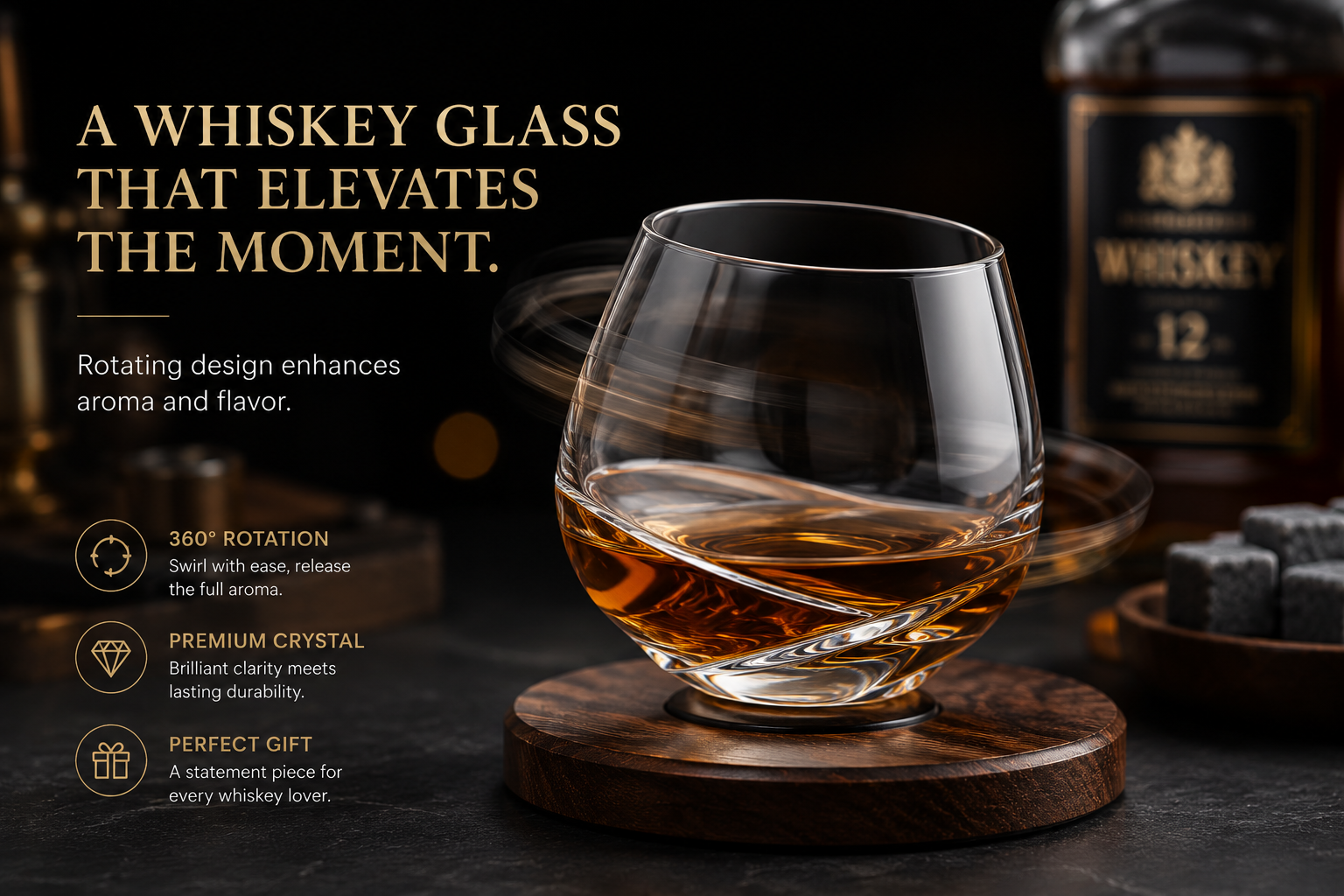
In many gift sets, the whiskey glass is simply one component among several.
But the glass can also become the product people remember.
Shape, proportions, visual character and the way someone interacts with the glass can influence the identity of the complete set.
A rotating whiskey glass, for example, creates a different interaction from a conventional rocks glass. A decanter-and-glass combination creates another type of presentation.
The objective is not novelty for novelty’s sake.
The difference should be noticeable **and relevant to the intended customer.**
A useful test is:
**If the outer packaging disappeared, would the product itself still have a recognizable identity?**
That question helps separate product differentiation from packaging decoration.
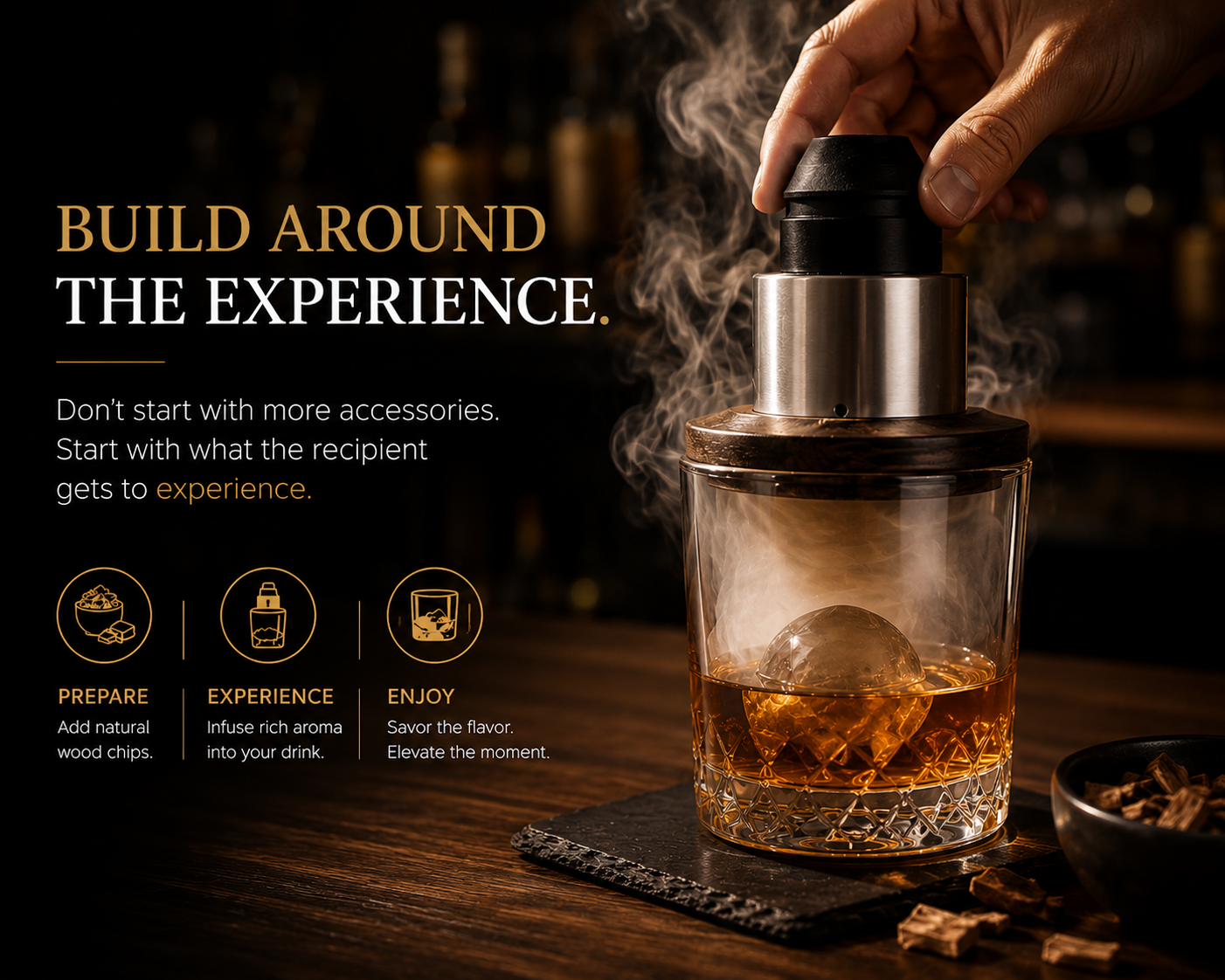
2. Build the Whiskey Gift Set Around an Experience
Another approach is to start with what the recipient will actually experience rather than how many components the box will contain.
A **whiskey gift set** might be developed around chilling, tasting, serving, smoking or home-bar entertaining.
This changes the development conversation from:
**“What else can we add?”**
to:
**“What should the recipient actually experience?”**
Once that answer is clear, it becomes easier to decide which components belong.
A smoker may make sense when the experience is built around aroma and preparation.
Whiskey stones or stainless steel chilling cubes may support a chilling-focused concept.
A decanter may make more sense when presentation and serving are central to the product story.
The goal is not to add accessories until the box looks full.
**Each component should have a reason to be there.**
## 3. Give the Gift a Clear Occasion
The product itself is only one part of gifting.
There is also a reason why someone is giving it.
As brands and corporate gifting buyers prepare for Q4 and year-end programs, this can become an important part of product development.
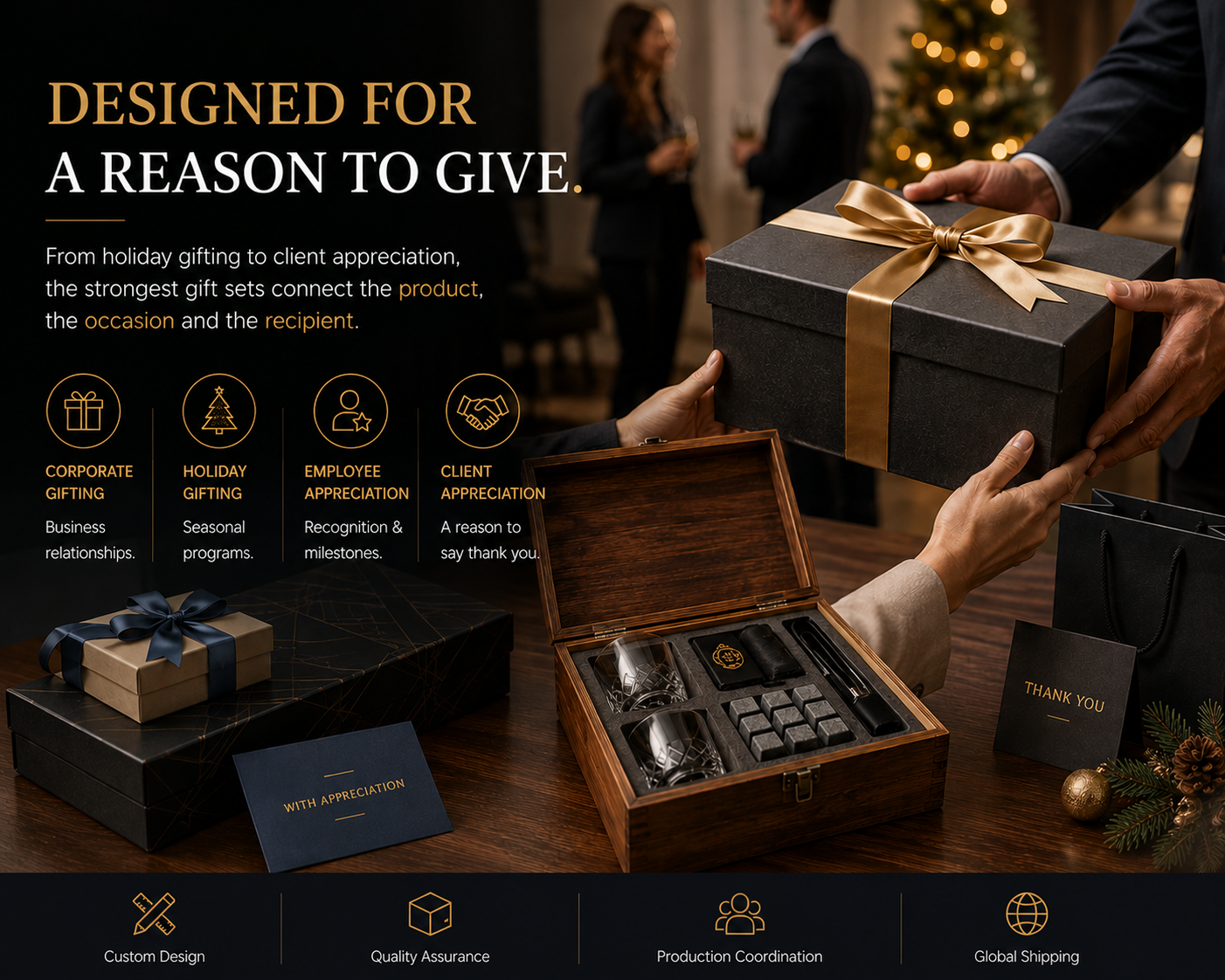
Depending on the project, a **holiday whiskey gift set** could be developed around Christmas gifting, year-end client appreciation, employee gifting, executive gifting or business partner gifts.
The products do not necessarily need to change completely for each occasion.
What changes is the logic connecting them.
For example, a **corporate whiskey gift set** may place more emphasis on presentation, appropriate personalization, branding consistency and recipient experience.
A private-label holiday collection may need the product and packaging to work within a broader seasonal assortment.
The important point is that the occasion should influence the concept — not simply become another graphic printed on the box.
## 4. Let Packaging Strengthen the Product Story
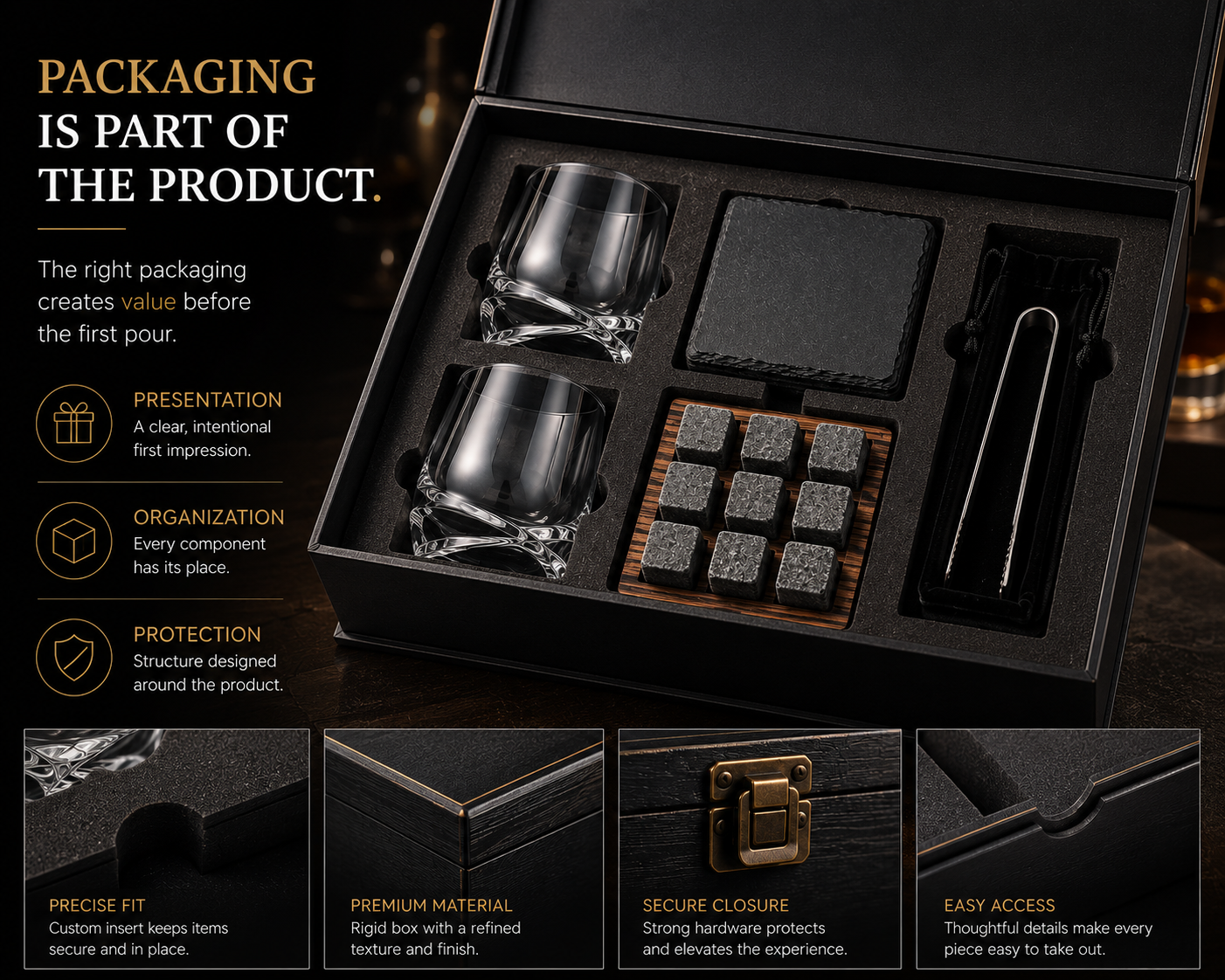
Packaging is particularly important for gift products because it has to perform several jobs.
For a **whiskey gift set**, packaging may need to organize the components, support product protection, communicate brand identity and create the right presentation when the recipient opens the gift.
That is why packaging should not always be treated as the final step.
Box structure, inserts, product arrangement, materials and opening sequence can all influence how the finished gift is perceived.
A wooden presentation box creates a different impression from a rigid magnetic box. Different inserts can also affect both presentation and product protection.
But there is an important distinction:
**Packaging should strengthen the product story — not compensate for the absence of one.**
## A Simple Test Before Developing the Next Set
Before finalizing a **private label whiskey gift set**, try completing one sentence:
**“This is the whiskey gift set for ______.”**
The blank could represent a particular recipient, gifting occasion, drinking experience or recognizable product feature.
This is not a marketing slogan exercise.
It is a simple product-development test.
If the sentence is difficult to complete, the product may still look attractive, but its reason to be chosen may not yet be clear.
If the answer is easy to explain, it becomes easier to decide what belongs inside the set, what does not, and what the packaging should communicate.
## Developing a Custom Whiskey Gift Set With SHUNSTONE
SHUNSTONE works with overseas B2B customers on barware, drinkware, accessories, packaging and gift-ready product combinations.
For a **custom whiskey gift set** or private-label project, development can begin from an existing product, a buyer brief, a product combination, a packaging direction or a new gifting concept.
Depending on the specific project, the process may involve product selection and configuration, OEM/ODM discussion, sampling and revision, packaging development, multi-material coordination, production follow-up and quality coordination.
The objective is not simply to put more items inside a box.
It is to consider how the **product + accessories + packaging + gifting scenario** can work together as one coherent offer.
Specific materials, customization options, packaging structures, MOQ, sample requirements, lead time, testing and compliance requirements should always be confirmed according to the individual project.
## Final Thought: Don’t Add More Just to Look Different
A **whiskey gift set** does not need to reinvent the category to become distinctive.
Familiar products can be an advantage because customers already understand them.
The opportunity is to give those familiar elements a clearer reason to be chosen.
Before adding another accessory, ask:
**What should people remember about this product?**
The glass?
The experience?
The recipient?
The occasion?
The personalization?
The packaging?
The answer will be different for every brand and sales channel.
But the difference should ideally be easy for both the buyer and the final customer to understand.
**Don’t add more just to look different.
Build a whiskey gift set with a clear reason to exist.**
Post time: Aug-27-2026